I Got My Hands Back

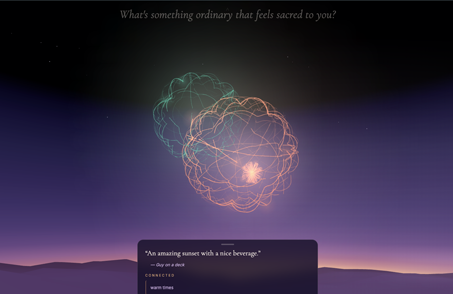
It's a little after midnight on a Tuesday and I can't sleep because there are spirographs orbiting a planet on my screen.
They're floating in a 3D twilight cosmos I built with my own hands, three hundred of them, each one drawn from a different sentence somebody might type into a question I haven't even finalized yet. The shapes rotate. The camera drifts forward through the dark.
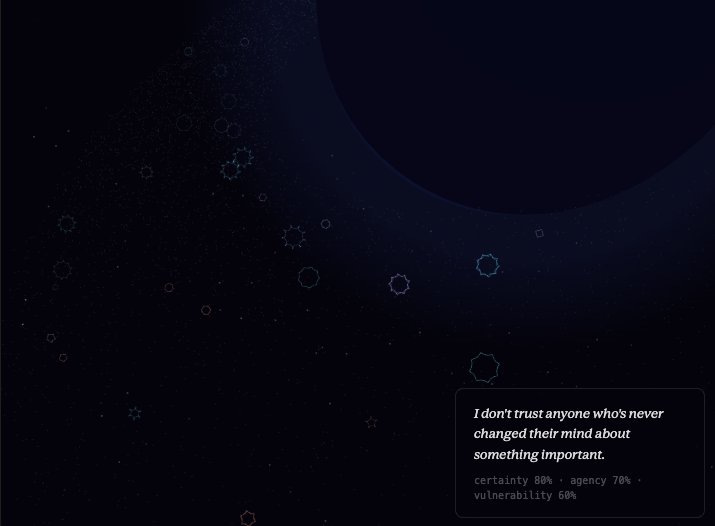
I just hit my Claude usage limit and I'm weirdly grateful, because otherwise I'd still be poking at this thing and the night would never end.
I keep staring at it. I made this.
I haven't felt quite like this in twenty years.
The slow weight of technology and growth
I used to build things, on my own, that shipped. Gold Key in multimedia, Webby nominee, ActionScript when ActionScript was a thing people respected. I sold my own work for years before email became my job. For many years I would develop a key piece of the multimedia experience we were selling, really until the opportunities and responsibilities coming my way made it impossible.
Over time, I got good at running companies and projects. PortlandLabs. Concrete CMS. Massive government web projects. I work with people I've known for decades, who I deeply respect, who do work I cannot do and frankly AI cannot either. Managing complex production pipelines gracefully. Designing client solutions from soup to nuts. Holding a hundred details in their head at once and making the right call. It's a fantastic team. The job has been good to me.
Here's the thing nobody tells you about the web getting better, though: every improvement comes with more weight.
We can build prettier websites, but it takes ten times the effort. We have personalization, but now somebody has to manually create content for every permutation of customer. We have analytics, and now you have to interpret them. Every new value add technology, every person who joins, every system that gets connected, creates more weight of management and context.
I've watched the web mature for thirty years and while it's prettier, it's actually a worse place to spend your time. I quit social media back in September and it's felt great. That should tell you something.
The job of making things on the web got bigger every year. The joy of it got smaller.
So when I tell you I haven't built anything digital with my own hands in twenty years, it's not because I forgot how or didn't have tremendous resources available to me as a CEO of a software company. It's because every tool that came along asked for more from me than it gave back. I stopped making and started managing the people who make.
What's different now is that AI doesn't add weight. It subtracts it. Suddenly the management of all that context (what we're building, why, for whom, with what constraints) gets easier, not harder. That's a thing I've never seen a new technology do.
The bet
Sunday I sat down with Claude to talk about my previous work and an itch I'd been sitting with: how do you make a piece of art that helps people see their connections to each other instead of their differences? Polarization is exhausting. Most of what gets built right now amplifies it. I wanted the opposite.
We talked it through. Claude pushed back on a few directions that were too preachy, suggested remixes of older ideas of mine, and over an hour or two the concept of The Between took shape. It's named after the philosopher Martin Buber, who described the idea that real human connection happens in the space between two people who actually encounter each other. The premise: ask people an open-ended question, run their answer through an AI that turns it into six emotional dimensions (certainty, vulnerability, that kind of thing), and use those dimensions to draw a unique spirograph. Each spirograph is a fingerprint of the thought behind it. Your thought floats in a shared cosmos with everyone else's who answered. If two thoughts resonate, they end up in orbit around each other.
I had no code. I haven't written real code since the aughts.
I decided to find out if I could build it anyway. Not pay someone. Not delegate. Build.
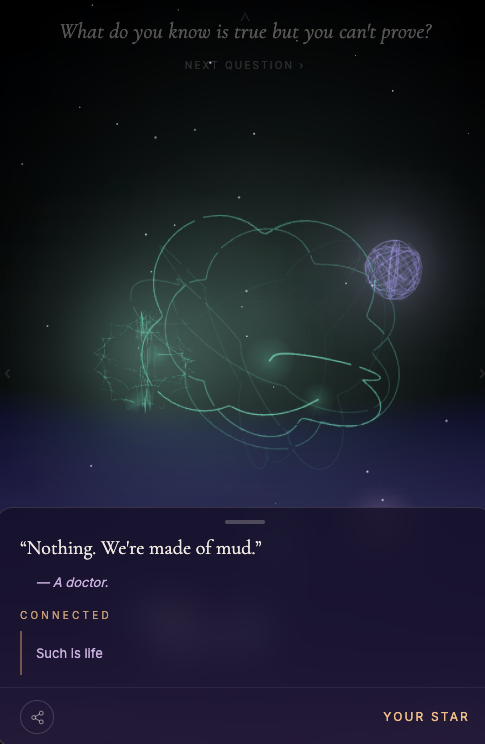
You can try The Between here. Five days from desire to launch. I never touched a line of code.
How the work actually worked
It started as a single Claude conversation. I'd describe a half-formed idea ("spirographs as emotional fingerprints") and Claude would push back, suggest remixes, ask what I was actually trying to say.
Then it became a Claude project. I had Claude help build a general prompt that would explain everything which I set as the instructions any prompt created in my project would understand. Inside the project I started spinning up specialist sub-chats. "You're a psychiatrist, help me write open-ended personal questions." "You're a color palette designer, help me find star colors that work on a twilight background." Each conversation produced something useful — a list, a prototype, a snippet of code — and I'd carry the result back to the main chat where the architecture lived.
Then came Claude Code, which runs in a terminal and actually builds the thing. I had two computers going. The big monitor ran Claude Opus in a browser for architecture and planning; the smart one, expensive, no ability to touch my files. The older agent laptop had no access to anything important, and ran Claude Code on Sonnet building the actual app one prompt at a time.
The pattern emerged on its own: design and decide on the big computer, hand off detailed instructions to the small one, watch it work. While Claude Code was thinking through a build task, I'd work on some emails, finish my wife's vintage-mall display case, write the next prompt. I cannot overstate how rare this is. Most tools demand your full attention. This one rewards patience.
If that all sounds elaborate, it wasn't. It emerged in a couple of days because each piece did exactly the job it was good at. Right model, right context, right tool.
The build
Sunday night the project was a concept and a domain name I'd bought on a whim. By Monday evening there was a live website at thebetween.world with a database humming behind it. By Tuesday afternoon I had a working prototype where you could type a sentence and watch a unique spirograph get drawn from your words. By Wednesday I had a 3D cosmos with stars in it. By Thursday those stars were orbiting each other based on emotional resonance. By Friday I launched it.
That's incredible.
The bootstrap moment was the first time the floor dropped out from under me. Monday night I handed Claude Code a generated prompt with a folder full of design files I'd built in Claude Design earlier that day, and an entire web application appeared on screen. Every page navigable. Twilight sky rendering correctly. Frosted glass UI components matching the prototype. Typography right. It wasn't functional yet — the database wasn't wired up, the AI dimension extraction wasn't connected — but the skeleton of the whole thing was there, with the actual visual design instead of placeholders. Twenty years ago that scaffolding would have been days of work. This took a few minutes. I sat there staring at it for a while.
It wasn't always smooth sailing. I never did find Vercel's free tier, I just paid for Pro. Facebook still won't render the Open Graph image when you share a link to The Between. Anthropic's billing UI told me I needed to add credits until I changed some settings that still make no sense to me. The infrastructure tax is still a tax. "Vibe coding" doesn't mean you just say "build me something cool!" and the wires connect themselves.
The actual creative work, though? That part felt like flying.
By Tuesday night I was so deep in it I built a side tool to tune the spirograph math with sliders.
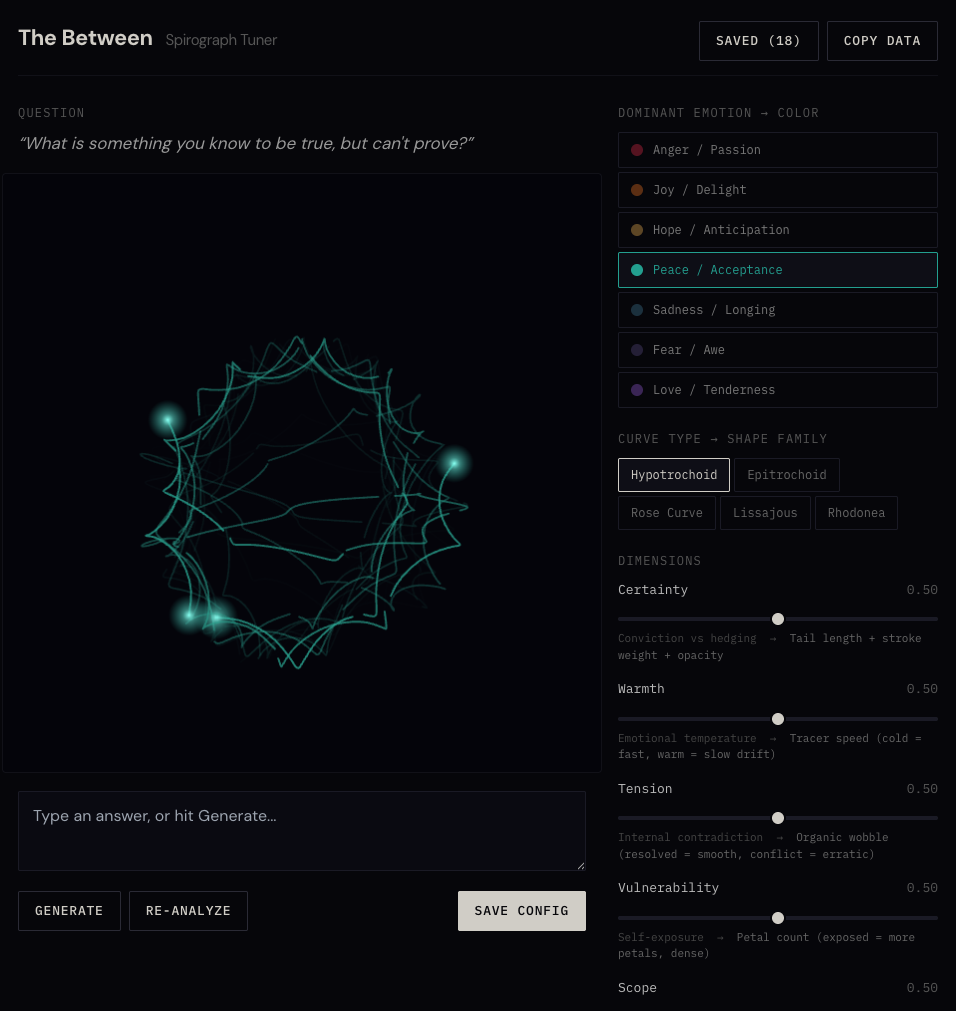
By Thursday I in the zone. I wouldn't even edit color values by hand locally. It's just easier to queue up a color tweak as a one-line aside at the top of the next big prompt; "give me a slider to adjust the sunset hue and show me the value so I can give you a better default." Done.
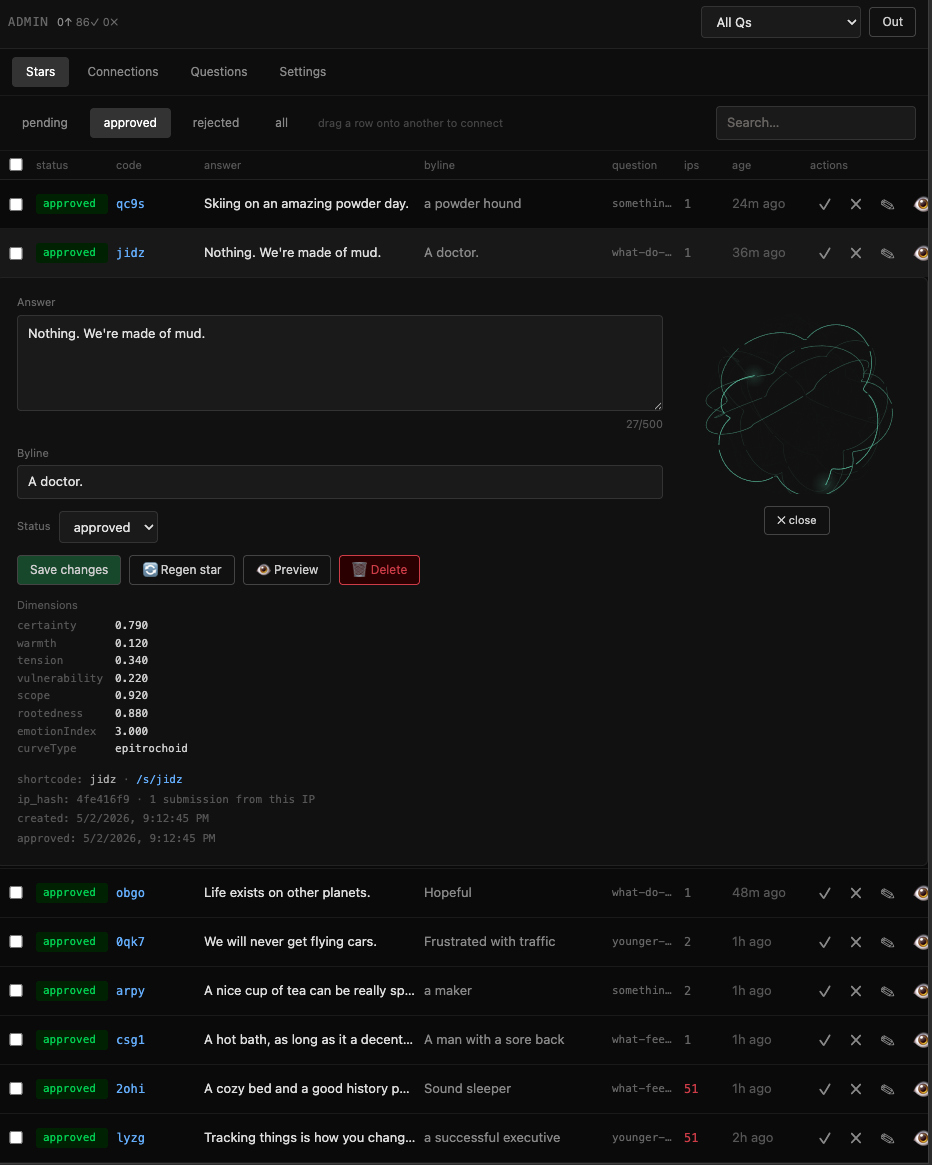
By Friday I had a full admin dashboard for managing the cosmos. Bulk approve, edit, delete stars, manage connections, regenerate spirographs, the whole thing. A week of work for a developer a few years ago. I gave Claude Code a prompt and it was working well in minutes. Full CRUD, search, bulk select and actions. Amazing. Want it mobile friendly? Just ask and go make coffee while it happens.
What it didn't do
I want to be careful here, because the AI conversation has more than enough breathless evangelism in it.
This worked because the stakes were low. The Between is an art project. If something breaks, nobody loses money, nobody's identity gets stolen, no regulator comes calling. A banking app would be a different story. A CMS handling personally identifiable information would be a different story. There are rooms AI is not ready to walk into unsupervised, and pretending otherwise is how people get hurt.
This worked because of what I brought to the table, and that was more than knowing I liked the color purple. Decades of interactive design instinct were doing real work the whole time. Knowing how software comes together. Knowing when to chase the high-res, expensive solution I wanted and trust that I could come back and optimize for performance later. Knowing which problems to solve in what order. Knowing when something looked nearly right but was actually subtly wrong, and being able to articulate why. Sometimes I'd just have to back away from an idea because of how I knew the UX was built. Claude will bend over backwards trying to build what you describe. Knowing what to describe, when to describe it, and how to recognize the answer when it came back — that's the real trick, and that's a skill that takes a long time to build.
This worked because I was the editor. Every prompt, every rejection, every "no, do it this way" was me doing the work AI cannot do — judgment about whether something was right, whether it served the idea, whether it was honest. That work didn't go away. If anything, there was more of it, because I was making creative decisions at a rate I hadn't in twenty years.
Here's the part that surprises people when I say it out loud: this is not a reason to hire fewer developers. This is a tool that turns good developers into epic producers. The work AI is good at (boilerplate, scaffolding, syntax, the long tail of infrastructure plumbing) was always the part that ate the soul of developers. Now that part can shrink. What's left is the work that actually requires a developer to think and be creative: architecture, judgment, knowing when something's wrong before it breaks, knowing what to build next. That's the work my team has always been great at, and now they get to do more of it.
If I can do this on my own, it's pretty damn exciting to think about what my team can do with their expertise.
Hands back
Friday around lunchtime I sent the link to a few friends and a few people on my team. Hearts came back from Andy and Evan in our AI channel at work. My friend Darryl texted me back: It's a Brave new world. (I should probably reread that book.) A few other people seemed to appreciate it but didn't quite register that I built this in a week. They thought I'd shared somebody else's project. When I explained, they got quiet for a second and then asked how.
This is a weird art project. It's also one of the coolest things I've ever made.
We're heading into a world where execution is no longer the bottleneck. The bottleneck is having a real idea, asking the right questions, and knowing when something's right. Those aren't skills AI can replace. Those are the skills creators have always had.
The wall came down. The makers are still the makers.
We just got our hands back.