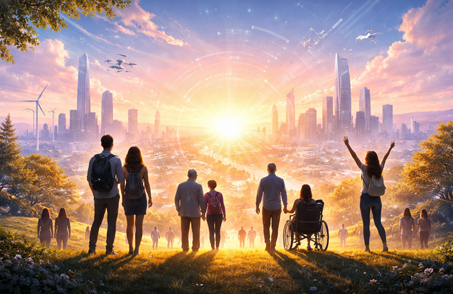
Take a breath, the future is bright.

Happy new year!
Maybe it’s because I just turned 50 in November and as you get older your perspective changes. Maybe it's because society really has taken a step towards pessimism. Maybe both are true. It seems there is no shortage of thought leaders warning of our impending doom. Politics has never been more divisive in my lifetime, and the zeitgeist around communication technology seems to be that AI and tech-bros are going to start a dystopian apocalypse, the only thing the media can’t agree on is how soon.
All of these concerns are real and fair. Politics is a train wreck right now, and the utopian promises of “surfing the web” from the 1990’s feel like nostalgic day dreams. I’m not here to dismiss concerns or tell you everything is going to be okay. Without your active involvement in demanding a better future, they most certainly will not be okay. What I am here to do, today, is give you some hopeful views to add to your considerations as you ponder your future at the end of our new year’s break.
Let’s start with the death of social media, just because that’s my jam. Those of us who loved BBS’s and IRC in the 1980’s never thought the web should turn into just Facebook and Twitter. The idea of a few well funded media companies choosing what information we see was very much central to why we turned off the TV and fired up our modems to dial into one another’s BBS’s back in the day. The model was all about decentralization. A few people could start a community they own, and build a place they loved to hang out. The technology to do that has only improved over the last 20 years. Sure, Facebook came in and offered to take any technical difficulties out of the equation and provide a free place to hang out if you would just suffer through their ads. Popular consensus of the younger generation seems to be quite clear that it’s not worth it. You can argue that Tiktok is the same thing and the younger generation simply picked a Chinese owned platform over a US one, which is a fair concern, but I think even tiktok is losing some of its allure.
Popular youtubers are moving to a model where they set up a privately owned community they host and directly connect with an audience that pays to be members. Platforms like Ghost.org and Substack make this easy, and more platforms like this are undoubtedly on the way. My 17 year old wanted (and got) a CD player for Christmas. A new minimal phone has become fashionable with some of the college students in my older daughter’s friend group. Sure, so are meta’s new non-stupid looking augmented reality glasses, but when I ask why, I’m given a list of specific functions everyone recognizes as valuable. No longer are we willing to suspend belief when tech-bros tell us something is cool and we should just trust them because everything is going to be awesome if we just leave them in charge. Their ideas are being met with skepticism, and that’s healthy.
AI is the easy punching bag when someone wants to write some fear mongering to get clicks. Two main fears seem to drive the conversation. First, AI will take your job. Second, AI will become sentient and decide that humans are a real drag and kill us all. Both of these fears deserve to be taken seriously, but they’re very reminiscent of the push back humans have had when any new technology emerges.
If you asked the Luddites in 1816 they would have told you that the mechanical loom and industrialization as a whole were going to ruin society. Fast forward a few years and the reality was while, yes, there were fewer people weaving cotton cloth by hand, those people found other ways to contribute to a new society where income disparity was shrinking, lifetimes were increasing, healthcare was improving and any metric you want to pick was better. Don’t be a fool for nostalgia, you don’t want to be a peasant in medieval times when simply getting some gook in your eye might mean an infected cyst and your untimely demise a few months later because you can’t even find clean water to rinse your eye out. Times have been hard for humanity, and they have consistently gotten better.
AI will absolutely change a lot of jobs. The same way the steam engine and eventually electricity changed a lot of jobs. That said, we still have all the same things we did before and so much more, we just take fewer people’s manual effort to pull them off. Ask the indentured servant at a furniture shop whose job it was to do nothing but sand wood if he’d appreciate an electric sander. I bet that individual would be perfectly happy to turn in their sandpaper for a headset and work at a customer support call center. Sure, that can be thankless work, but have you ever sanded wood for a whole day? Will AI be the end of call centers? Probably not entirely, but yeah certainly fewer front-line workers will have jobs helping people with obvious repeatable tasks that AI can handle. Much like the reduction of manual labor in the industrial revolution, this will end up being a good thing.
The second question, will AI decide we’re fools that should be eliminated? Anything’s possible, but I don’t see it happening soon. I use AI every day. Just used it to look up the date on that luddite reference, and man it sure is useful. That said, the LLMs today are effectively extremely powerful spell check. They’re guessing what word will most likely make you happy next, and that’s it. Sure that’s a handy trick, but that’s a far way from sitting on a throne stroking your goatee plotting world domination. The more experts you get a drink or two into and ask “how far do you really think AGI is” (Artificial General Intelligence) the more far off it tends to sound. It’s a thing to be thoughtful about, for sure, but it’s not a guaranteed eventuality and it’s certainly not 2 years away.
Politics is depressing, but it’s been depressing before. In the 1960’s political leaders were routinely being assassinated. In 1856 Charles Sumner was nearly beaten to death on the Senate floor after a speech about slavery. Andrew Jackson was called “A violent demagogue… unfit for the station of President. An adulterer who lives in open and notorious violation of the laws of God and man.” This was back in 1828, and yet - here we are, 2026, and still the world’s biggest economy.
Don’t get me wrong. Letting a few rich white guys in San Francisco turn the world wide web into network TV was a mistake. AI changes how our economy works and if we’re not thoughtful about sharing the wealth it creates, we’ll create a great deal of angry hungry people. We must figure out a way to have political discussions where nuance and middleground are appreciated. I’m not trying to tell you these aren’t huge, existential issues you should be worried about. I’m just trying to offer a goal worth fighting for.
Imagine a future where how your mind actually works and the pursuit of happiness is something you are encouraged to work on with ever improving tools for understanding how to achieve it. That’s what I see today when I look at the wealth of thinking that has happened in the last 30 years on motivation, habits, well-being, mental health, and self improvement.
Imagine a future where people live healthier lives and stay active longer into old age. In 1900 the global average life expectancy was about 32 years. Today is about 73 years, and while those improvements may have flatlined after covid in the US, they continue to improve in the rest of the world.
Imagine a future where universal basic income and other measured socialist ideas are embraced alongside capitalism with a recognition that “winner takes all” is a great motivation for some types of business, but perhaps not every social need. Andrew Yang’s campaign shows you’re not alone in this thinking, and the increasing number of generation Z that clearly think unchecked capitalism is dangerous is inspiring. Leaders like Bill Gates, Warren Buffet and yes even Mark Zuckerberg committing to give away at least half of their wealth before they die is the right idea and we should continue to applaud that social expectation as the right way to get ultra-rich. Prove you’re the best, then help the rest.
Imagine a future where it’s easy to learn any new skill from anywhere in the world with nothing more than a phone. This one’s pretty easy, we often say “oh I learned how to do that at YouTube University” in my home. Go ask chatty-G to put a learning plan together for your next interest and enjoy. Instead of worrying about AI taking your job, try letting AI help you with some of the grunt work in your job so you can stay motivated and get a little more done.
Imagine a future where gene-splicing, RNA-based vaccines, AI, robotics, and other scientific breakthroughs help people stay active and live their best lives. Consider how our understanding of mental health has evolved over the last 30 years: instead of lumping everyone who thinks differently into a single derisive label, we now have better language, medicine, and insight. We’re not only learning how to support people who aren’t neurotypical, we increasingly recognize the strengths in how they see the world. Companies hire autistic specialists to lead complex testing and quality-assurance work, and many in the startup community see ADHD as a trait that often aligns with creativity, energy, and entrepreneurial drive.
It’s entirely possible to imagine an apocalyptic future where AI and a gilded tech elite turn the world upside down. It’s even helpful to do that from time to time to make sure we’re putting some checks and balances in place as events unfold. It’s also healthy to spend as much time imagining a world where technology and human achievements lead to a better world for all of us. So far, a little worrying about the former has helped us pull off the later, and in 2026, I expect to see more of the same. As you consider your plans and goals for the next year, make sure to set aside some time to celebrate wins and be thankful that you’re living in absolutely the best time possible in all of history.